
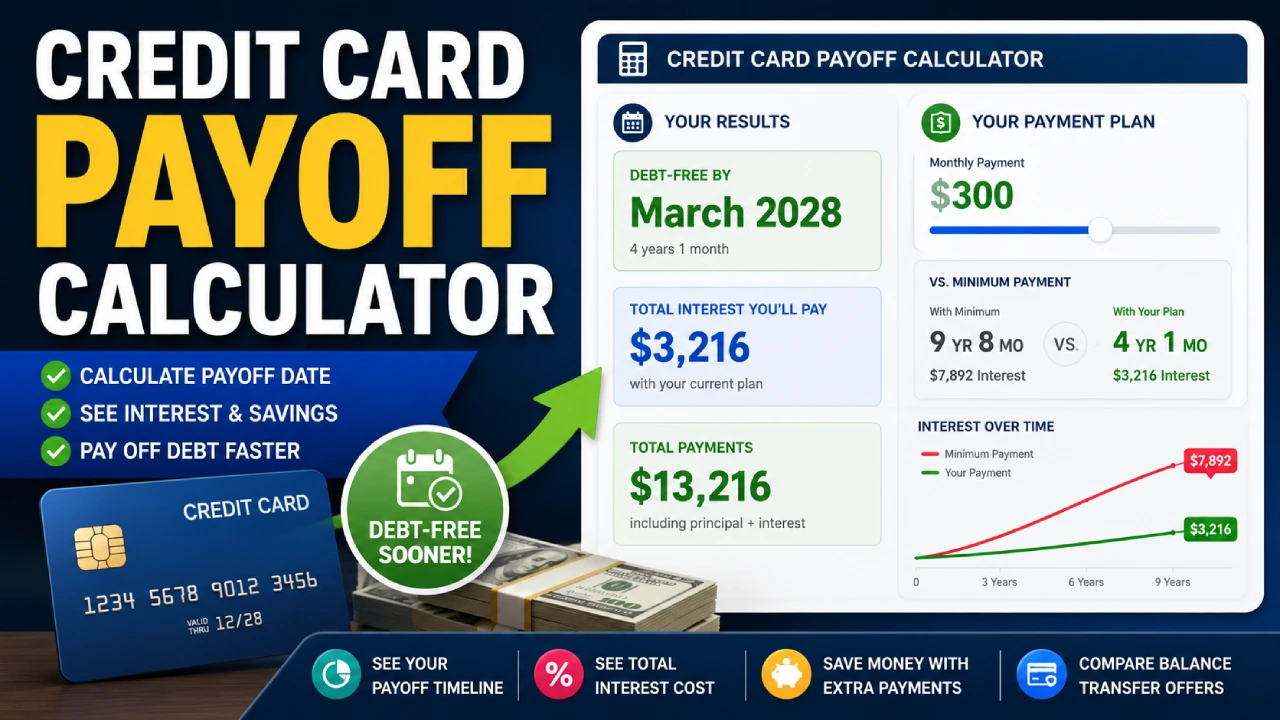
Find out exactly when you’ll be debt-free
Enter 3 numbers. See your payoff date, true cost, and how to get there faster.
Your numbers
Check your latest statement or card app.
Please enter a balance greater than $0.
Find this on your card statement under “APR”.
Please enter an APR between 0.1% and 49.99%.
Minimum payment: $114/mo
The minimum payment is calculated as 1% of your balance plus that month’s interest charge. As your balance shrinks, the minimum drops too — which is why paying only the minimum takes so long. A smaller minimum means less goes to principal each month.⚠ At this payment level, most of your money goes to interest, not principal. Even a small increase each month makes a big difference.
Payment must be higher than the minimum to pay off your balance.
You will be debt-free by
–
Total interest
–
On top of your balance
Total paid
–
Principal + interest
Your plan vs. minimum payments only
What if I paid a little more each month?
Drag the slider to see how extra payments change everything.
Tips based on your numbers
Consider a balance transfer – but know the fees first
Call your bank – it costs nothing
You can call the number on the back of your card and ask for a lower interest rate. If you’ve never missed a payment, there’s a real chance they’ll say yes. It takes 5 minutes and costs nothing to ask.
Pay the highest-APR card first
If you have more than one credit card, always pay the highest-APR card first while paying minimums on the others. This is called the avalanche method and saves the most in interest over time.
Set up autopay today
Set up autopay for at least your minimum payment. A single missed payment can trigger a penalty APR up to 29.99% on most US cards – and it stays on your credit report for 7 years.
You’re almost there – keep going
Results are estimates based on a fixed APR and consistent monthly payments with no new purchases added. Actual payoff time may vary if your interest rate, minimum payment, or spending changes. This tool is for informational purposes only and does not constitute financial advice.
If you've ever looked at your credit card statement and felt overwhelmed, you're not alone. Most Americans are carrying a balance right now - and the interest charges quietly grow every single month. This calculator shows you exactly when you'll be debt-free and how much that freedom costs you in interest. More importantly, it shows you what happens when you pay just a little more each month.
Before you use the tool, here's the bigger picture on where Americans stand with credit card debt in 2026:
Those numbers sound abstract until you run your own balance through a payoff calculator. Then it gets personal fast. The good news: even a $25 or $50 extra payment per month can shave months off your timeline and save hundreds in interest.
How to Use This Credit Card Payoff Calculator
The calculator above is designed to be as simple as possible - just three inputs:
- Current balance - find this on your latest statement or your card's mobile app. Use the balance as of today, not your credit limit.
- APR (Annual Percentage Rate) - this is your interest rate. It's listed on every statement, usually near the bottom, under a section called "Interest Charge Calculation" or "Account Summary." If you're not sure, 20.97% is the national average as of late 2025.
- Monthly payment - the slider auto-sets to your minimum payment. Drag it up to see how extra payments change everything.
Tip: The calculator automatically shows what happens if you only pay the minimum. Use the "What if I paid a little more?" slider at the bottom of the results to see the impact of adding even $25 a month - the difference is usually surprising.
The Minimum Payment Trap - Why It Takes So Long
Credit card companies calculate your minimum payment to be as low as possible - typically the greater of $25 or 2% of your balance. This keeps you paying interest for as long as possible. It's not a conspiracy; it's just how compound interest works against you when the balance is high and the payment is low.
Real example - $6,500 balance at 20.97% APR
Notice how going from $200 to $300 per month saves over 20 months and nearly $1,500 in interest. That extra $100 per month is doing a lot of work. This is why the "What if I paid more?" section of the calculator matters so much.
Important: More than 27 million Americans currently pay only the minimum each month, according to a 2026 analysis by The Century Foundation. At the national average APR, paying only the minimum on a $6,500 balance means you're paying mostly interest - your principal barely shrinks each month.
Credit Card APR by Card Type - Is Your Rate Normal?
One of the most important things to know before making a payoff plan is whether your APR is average, good, or costing you more than necessary. APR varies significantly depending on what type of card you have, your credit score, and who issued it.
| Card Type | Typical APR Range (2025-2026) | Rating | Notes |
|---|---|---|---|
| 0% Intro / Balance Transfer | 0% for 12-21 months, then 18-28% | Best | Ideal for paying down existing debt fast |
| Rewards / Travel Cards | 19% - 28% | Average | High rewards, but carrying a balance wipes out rewards value |
| Cash Back Cards | 16% - 28% | Average | Lower end available for good credit scores (700+) |
| Student Credit Cards | 18% - 27% | Average | Designed for limited credit history; APR drops as score improves |
| Secured Credit Cards | 22% - 29% | High | For rebuilding credit; avoid carrying a balance |
| Store / Retail Cards | 28% - 35.99% | Very High | Avg store-only card APR was 31.64% in 2025 (Bankrate). Highest risk. |
If you're carrying a balance on a store or retail card, that's the most urgent debt to address - the interest compounds faster than almost any other consumer product. A $2,000 balance at 31% APR costs $620 per year in interest alone, even if you never make another purchase.
APR Ranges by Major Card Issuer (2025-2026)
If you're considering switching cards or want to know how your issuer compares, here's how the major U.S. banks stack up on purchase APR across their card portfolios:
| Card Issuer | Purchase APR Range | Known For | Good Fit If... |
|---|---|---|---|
| Chase | 18.99% - 28.49% | Travel rewards, Chase Sapphire, Freedom | You have good credit and pay in full monthly |
| American Express | 13.99% - 29.99% | Premium rewards, business cards | High spenders who pay balances in full |
| Citi | 18.24% - 28.24% | Balance transfer offers, cash back | Paying down debt - strong 0% intro offers |
| Discover | 11.99% - 27.99% | Cash back, student cards, low low-end APR | First card or rebuilding credit history |
| Capital One | 19.99% - 29.99% | Secured cards, travel, Venture rewards | All credit levels - widest range of products |
| Bank of America | 12.99% - 27.99% | Cash rewards, travel, Preferred Rewards | Existing BofA customers - rate discounts available |
| Wells Fargo | 19.24% - 29.99% | Active Cash, balance transfers | Simple flat-rate cash back with no annual fee |
Note: The APR you actually receive depends heavily on your credit score. The ranges above show the full spectrum each issuer offers - excellent credit (750+) typically gets the lower end; fair credit (580-669) typically lands near the top.
5 Proven Ways to Pay Off Credit Card Debt Faster
Numbers from the calculator motivate you. These strategies show you how to act on them.
Call and ask for a lower rate
Call the number on the back of your card and politely ask to lower your APR. If you've never missed a payment, it works more often than you'd expect - and it costs nothing to ask. Even a 3-4% reduction can save hundreds.
Use a 0% balance transfer card
Many U.S. cards offer 0% APR for 12-21 months on transferred balances (Citi, Discover, Chase all have strong offers in 2026). You'll pay a 3-5% transfer fee, but if you can pay the balance down during the intro period, you save far more.
Avalanche method - highest APR first
If you have more than one card, always put every extra dollar toward the highest-APR card first, while paying minimums on the others. Once that card is paid off, roll that payment to the next highest. This saves the most money overall.
Set up autopay to avoid penalty rates
A single missed payment can trigger a penalty APR of up to 29.99% on most U.S. cards - and it stays on your credit report for seven years. Set autopay for at least the minimum, then add extra payments manually when you can.
Round up or pay biweekly
If your minimum is $130, pay $150 or $200. Or split your payment in two - pay half every two weeks instead of once a month. You'll make one extra payment per year and reduce the average daily balance that interest is calculated on.
Consider a personal loan to consolidate
Personal loans from banks and credit unions often come at 10-16% APR - significantly lower than most credit cards. Rolling high-interest card debt into a fixed-rate personal loan gives you a clear end date and usually a lower monthly cost.
Avalanche vs. Snowball vs. Balance Transfer - Which Strategy Is Right for You?
There's more than one way to approach credit card payoff. Here's how the three most common strategies compare, so you can choose what fits your situation:
| Strategy | How It Works | Best For | Saves Most Money? | Fastest Wins? |
|---|---|---|---|---|
| Avalanche Method | Pay highest-APR card first, minimums on the rest | Anyone who wants to minimize total interest paid | Yes ✓ | No ✗ |
| Snowball Method | Pay smallest balance first, minimums on the rest | People who need motivation from visible wins | No ✗ | Yes ✓ |
| Balance Transfer | Move balance to a 0% intro APR card, pay aggressively | Good-to-excellent credit (670+); balance payable in 12-21 mo | Yes ✓ | Yes ✓ |
| Debt Consolidation Loan | Personal loan at lower APR to pay off all cards | Multiple cards, large balances, stable income | Usually ✓ | Varies |
The right strategy depends on your credit score, how many cards you have, and whether you respond better to financial logic (avalanche) or emotional momentum (snowball). Both work - the best one is the one you'll actually stick with.
How Credit Card Debt Affects Your Credit Score
Your credit score is directly tied to how you handle credit card debt - not just whether you pay on time, but how much of your available credit you're using. This is called your credit utilization ratio, and it makes up roughly 30% of your FICO score.
- Under 10%: Excellent - shows lenders you use credit responsibly
- 10-29%: Good - the generally recommended range
- 30-49%: Fair - starting to drag your score down
- 50%+: Harmful - significantly impacts your ability to get loans, mortgages, and better card rates
The average American credit utilization rate is 29% as of 2025 - right at the edge of the "good" range. Paying down your balance isn't just about avoiding interest. Every thousand dollars you pay off improves your score, which in turn qualifies you for lower APRs on future products.
Quick win: If you can pay your balance down to under 30% of your credit limit - even before you fully pay it off - you may see a meaningful credit score improvement within 1-2 billing cycles. Use that improved score to negotiate a better rate with your issuer.
Frequently Asked Questions
It depends entirely on your APR and monthly payment. At the national average APR of around 21-24%, here's what $5,000 looks like at different payment levels:
- Minimum only (~$100/mo): roughly 8-9 years, paying $3,500+ in interest
- $150/month: about 4 years, roughly $2,000 in interest
- $200/month: about 2 years 8 months, roughly $1,300 in interest
- $300/month: about 1 year 8 months, roughly $780 in interest
Use the calculator above with your exact balance and APR for a precise payoff date.
As of March 2026, the average APR on new credit card offers is 23.79%, according to Federal Reserve G.19 data. For all existing accounts (including older cards opened at lower rates), the Federal Reserve reported an average of 22.30% as of November 2025.
This is near historic highs. Before the Federal Reserve's rate hike cycle began in 2022, the national average was 16-17%. Despite multiple Fed rate cuts in late 2024 and 2025, credit card issuers have been slow to pass savings on to cardholders.
Store and retail credit cards are much higher - averaging 30.14% in 2025 according to Bankrate's annual Retail Cards Study, with some cards hitting 35.99%.
Paying only the minimum is one of the most expensive financial habits an American can have. Here's why: your minimum payment is typically calculated as 2% of your balance (or $25, whichever is greater). At a 21% APR, roughly half of that minimum goes to interest - meaning barely any principal is paid down.
On a $6,500 balance at 21% APR with a $130 minimum, it takes over 7 years to pay off and costs more than $4,000 in interest - on a debt you originally had control of. The balance also decreases slowly at first, meaning those early payments are almost entirely interest.
Over 27 million Americans are currently in this exact situation, paying minimum payments monthly and making almost no progress on their principal.
A balance transfer moves your existing credit card debt to a new card that offers a 0% introductory APR for a set period - usually 12 to 21 months. During that time, every dollar you pay goes entirely to principal, not interest.
Most balance transfer cards charge a fee of 3-5% of the transferred amount. So on a $5,000 balance, you'd pay $150-$250 upfront. If you'd otherwise pay $800+ in interest over the same period, the math strongly favors the transfer.
Balance transfers make the most sense when: you have good to excellent credit (670+ FICO), you can realistically pay off the balance during the intro period, and the transfer fee is less than the interest you'd otherwise pay. If you can't pay it down in time, the post-intro APR kicks in - often 22-28% - which can put you back where you started.
Yes - dramatically. This is one of the most underestimated facts in personal finance. Because credit card interest compounds monthly, even a modest increase in your payment has a disproportionate impact on total interest and time to payoff.
On a $6,500 balance at 21% APR: increasing your monthly payment from $130 (minimum) to just $200 saves over 3 years and more than $1,500 in interest. Going from $200 to $300 saves another 20 months and roughly $1,450 more. The first extra dollars you put toward principal do the most work.
Use the slider in the calculator above to see exactly what an extra $25, $50, or $100 per month saves on your specific balance and rate.
Yes - and it's one of the most underused strategies in the U.S. Many cardholders don't realize this is even an option. The process is simple: call the number on the back of your card, ask to speak with a customer service representative, and politely request a lower APR.
It works best if you've been a customer for at least a year, have never (or rarely) missed a payment, and can mention that you've received offers from other issuers. You don't need to have received an actual competing offer to mention it. Issuers would rather reduce your rate slightly than lose you as a customer - especially if you're a reliable payer.
Even a 3-5 percentage point reduction can save hundreds of dollars over the life of your payoff plan, particularly on larger balances.
Take the First Step Today
The hardest part of paying off credit card debt isn't the math - it's starting. The calculator above gives you a clear, honest picture of where you stand and what your path looks like. Use it, screenshot your results, and set a specific payment amount you'll commit to this month.
Even if you can only add $25 to your monthly payment right now, do it. Your future self - and your wallet - will thank you. And once that first card is paid off, take every dollar you were sending to it and redirect it to the next balance. That momentum is real, and it works.
Bookmark this page and revisit the calculator every few months to track your progress. Seeing the debt-free date move closer is one of the most motivating things in personal finance.
Data sources: Federal Reserve G.19 Consumer Credit Report (Nov 2025, Mar 2026); TransUnion Q4 2025 Credit Card Debt Report; Federal Reserve Bank of New York Consumer Credit Panel Q4 2025; Bankrate Annual Retail Cards Study 2025; WalletHub Credit Card Debt Study 2026; Capital One / Motley Fool research 2026. APR ranges are approximate and change frequently - verify directly with card issuers before making financial decisions. This tool is for educational purposes only and does not constitute financial advice.